The Babalon Working — Level 2
The House on Orange Grove
At 1003 South Orange Grove Avenue, rocket engineers, artists, occultists, and seekers shared a house that would become one of the strangest addresses in Pasadena.
1003 South Orange Grove Avenue
In Pasadena, South Orange Grove Avenue was known for large homes and wealthy residents. Jack Parsons' address stood within that world, but what developed behind its doors was anything but conventional.
Parsons lived at 1003 South Orange Grove Avenue, a sprawling property that became known among those around him simply as the Parsonage.
Rooms were rented to an unusual mix of residents. Artists, writers, engineers, occultists, and people drawn to unconventional lifestyles moved through Parsons' orbit. The household developed a reputation for ignoring many of the social expectations of 1940s America.
But the Parsonage was more than an eccentric communal home.
It became closely connected to Agapé Lodge, the Southern California branch of the Ordo Templi Orientis in which Parsons had become a leading figure.
Ceremonial magic was not something Parsons left outside when he came home.
He brought it through the front door.
Meetings, discussions, relationships, and occult practice increasingly overlapped inside the same household.
That combination made the Parsonage an extraordinary intersection: people connected to serious scientific work could occupy the same social world as devotees of Aleister Crowley's Thelema.
And Parsons was becoming more important inside that second world.
By the mid-1940s, the rocket engineer introduced in Level 1 was no longer merely studying occult ideas.
He was helping lead a community built around them.
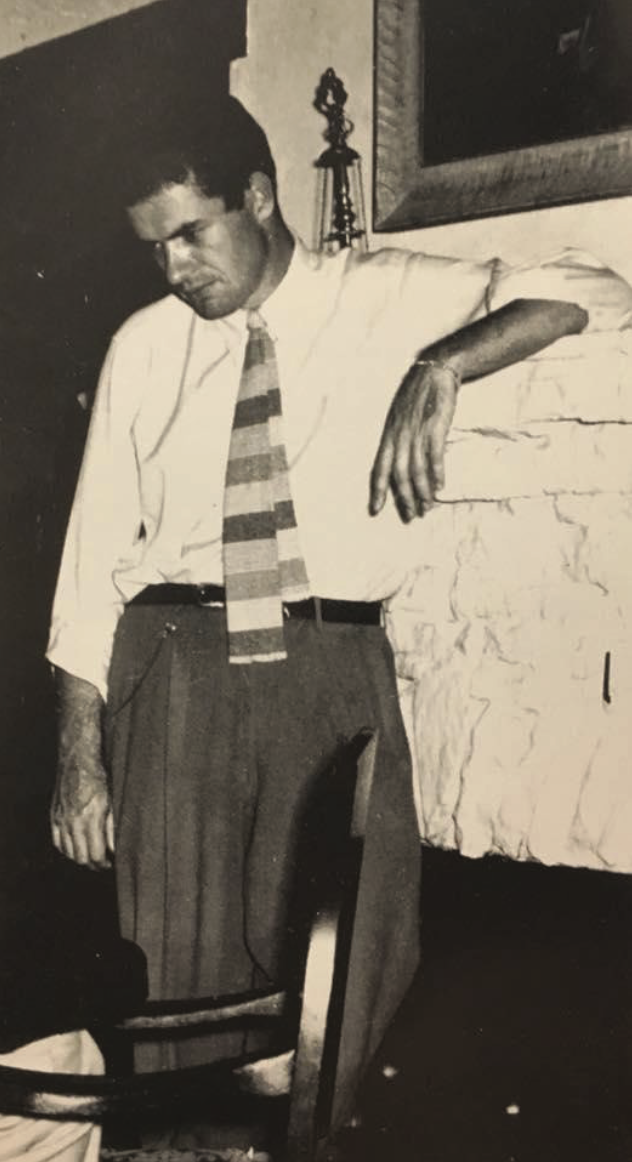
IMAGE SOURCE: The California Tech — “Jack Parsons: The Paradoxical Figure Who Revolutionized Rocketry”
IMAGE IDENTIFICATION: Jack Parsons at the Parsonage, 1942
RIGHTS LABEL PROVIDED BY SOURCE: Public Domain
Agapé Lodge
The occult activity surrounding Parsons was connected to a real organization: Ordo Templi Orientis, commonly abbreviated O.T.O.
Its Southern California branch, Agapé Lodge, practiced the religious and magical system associated with Aleister Crowley's Thelema. Parsons became one of the lodge's most important figures and eventually its leader.
Crowley himself remained thousands of miles away, but correspondence connected him to what was happening within the American lodge. Parsons was not simply reading Crowley's books in isolation. He belonged to an organized occult network whose members exchanged teachings, rituals, letters, and reports.
That makes what happens next important.
Because the Babalon Working did not emerge from nowhere.
Parsons had spent years moving deeper into ceremonial magick before 1946 ever arrived.
By 1945, Parsons' professional and personal worlds were changing.
His relationship with the rocket establishment had become increasingly complicated, while life at the Parsonage remained turbulent and unconventional.
Then someone new entered the household.
A writer.
A former U.S. Navy officer.
A man fascinated by extraordinary ideas who quickly developed a close relationship with Parsons.
His name was Lafayette Ronald Hubbard.
L. Ron Hubbard.
Years before Scientology existed, Hubbard had just stepped into Jack Parsons' occult world.
Evidence
THE SCRIBE
Parsons' surviving record of the Babalon Working repeatedly refers to a magical partner identified as “the Scribe.”
Scholarly examination of the Working identifies that Scribe as L. Ron Hubbard.
This is not a connection invented after Hubbard became famous through Scientology. Contemporary material from the O.T.O. circle also places Hubbard at Parsons' 1003 South Orange Grove Avenue residence before the Babalon Working reached its final phase.
The future founder of Scientology was inside the Parsonage.
And according to Parsons' account, he was about to participate directly in the operation.
documented
SOURCE: Henrik Bogdan, “The Babalon Working 1946: L. Ron Hubbard, John Whiteside Parsons, and the Practice of Enochian Magic,” Numen 63 (2016), 12–32.
PRIMARY MATERIAL IDENTIFIED: Parson's correspondence and typescript of The Book of Babalon, Gerald Yorke Collection, Warburg Institute, University of London.
The Partnership
Hubbard's arrival at the Parsonage quickly became more significant than that of an ordinary houseguest.
Parsons came to regard him as unusually capable. In correspondence from this period, Parsons described Hubbard in striking terms and indicated that he believed Hubbard possessed exceptional qualities.
Whatever Hubbard personally believed about Parsons' occult worldview, the historical record places the two men together during the period immediately preceding the Babalon Working.
And Parsons was preparing for something specific.
He wanted to conduct an operation intended to attract what he described as an “elemental”—a woman who would become part of a much larger magical undertaking.
For that operation, Parsons needed someone to assist him.
He chose Hubbard.
In January 1946, the experiments began.
Parsons would perform the invocations.
Hubbard would serve as the Scribe.
What happened during those nights was later recorded by Parsons himself—complete with dates, ritual procedures, unusual experiences, and his interpretation of what followed.
The house on Orange Grove had stopped being merely the setting.
It had become the laboratory.
Level Cliffhanger
Parsons had chosen his Scribe. In January 1946, he and L. Ron Hubbard began the operation. Parsons would later leave behind a record of what they did—and what he believed answered them.
The rabbit hole continues
Descend to Level 3 →