They Found Each Other Online — Level 1
They Found Each Other Online
Before the investigations crossed state lines, there was an online community, a failed experiment at sea, and a set of ideas growing stranger by the year.
BEFORE THE BODIES, THERE WERE IDEAS.
Long before investigators began tracing the same names across multiple states, there was an online world built around an enormous question:
What happens if humanity creates an intelligence more powerful than itself?
In the San Francisco Bay Area, a loose community of programmers, researchers, philosophers, and self-described rationalists spent years debating artificial intelligence, decision theory, existential risk, morality, and how human beings could learn to think more clearly.
Much of that conversation happened online.
Forums became meeting places. Ideas became identities. People who might never have found one another anywhere else suddenly could.
And somewhere inside that world, a much smaller circle was beginning to form.
THE RATIONALISTS
The larger rationalist community was not a violent organization, nor should what eventually happened around a small splinter circle be treated as representative of it.
Its members explored subjects ranging from probability and cognitive bias to artificial intelligence and the possibility that advanced AI could someday pose an existential threat to humanity.
One institution in this world was the Center for Applied Rationality, or CFAR, which ran workshops intended to improve reasoning and decision-making. Another was the Machine Intelligence Research Institute, or MIRI, which focused on risks associated with advanced artificial intelligence.
Jack LaSota—who wrote online under the name Ziz—entered this world as a software developer interested in many of the same questions.
But LaSota would not remain simply another participant.
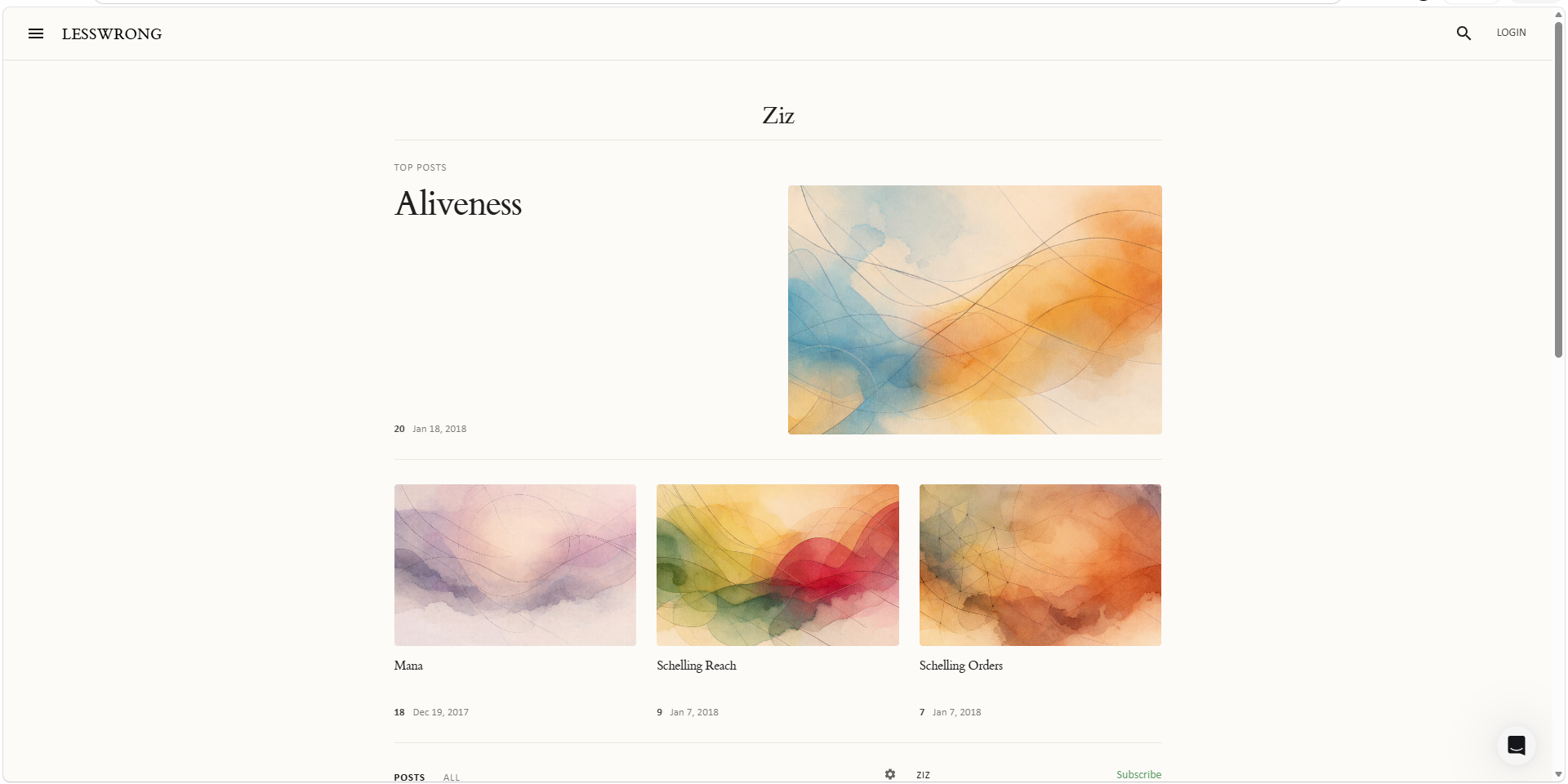
ARCHIVAL NOTE: This is a current screenshot of the surviving LessWrong profile under the name “Ziz.” It is not a screenshot captured in 2017 or 2018. The profile preserves posts dated from that period, including Mana, Schelling Reach, Schelling Orders, and Aliveness.
Source: LessWrong — public user profile, “Ziz.” Accessed September 2026.
THE PLAN WAS TO SAVE THE WORLD.
In 2016, LaSota attended an eight-day program run by the Center for Applied Rationality focused on artificial-intelligence safety strategy.
The fear underlying much of this world was enormous: if sufficiently advanced artificial intelligence arrived before humanity understood how to control it, the consequences could be catastrophic.
But there was a much more ordinary problem.
Rent.
Living in the Bay Area was expensive. LaSota and Gwen Danielson began discussing whether cheaper housing could free people to spend more of their lives working on problems such as AI safety.
Their solution wasn't an apartment.
It was a fleet of boats.
THE RATIONALIST FLEET
LaSota and Danielson began living aboard boats in the Berkeley Marina and developed an idea they called the Rationalist Fleet.
The concept was unusual but straightforward: create inexpensive floating housing for people in the rationalist community, reducing living costs while giving them more time to work on problems they believed could determine humanity's future.
Then the idea became much bigger.
In 2017, LaSota, Danielson, and another buyer acquired an aging former military tugboat called the Caleb in Ketchikan, Alaska.
It was approximately 94 feet long.
LaSota recruited people through rationalist networks to help move the vessel roughly 1,500 miles down the Pacific coast toward the San Francisco Bay Area.
On July 20, 2017, the Caleb headed south.
A philosophical community born partly on the internet was now physically together aboard an old tugboat in the Pacific Ocean.
Evidence
THE RECRUITMENT PITCH
On July 1, 2017, Jack LaSota posted a recruitment message online seeking people willing to help move the Caleb from Alaska to the San Francisco Bay Area.
The offer was remarkably simple: help crew a tugboat down the Pacific coast, and expenses would be covered.
LaSota also reached into the rationalist community for recruits. Within weeks, a small crew had assembled.
On July 20, the Caleb left Alaska.
What had started as conversations about cheaper housing and artificial-intelligence safety had become a 1,500-mile voyage aboard a decades-old military tugboat.
documented
The voyage did not unfold like the beginning of something sinister.
Crew members joked. Dolphins appeared beside the vessel. One passenger even uploaded a video from the trip set to comedy music.
But after the Caleb reached California, keeping the enormous aging vessel operational became increasingly difficult.
Cheap housing had come with a different price.
The crew now had to keep a 94-foot tugboat alive.
And aboard that boat, increasingly separated from the larger rationalist community, LaSota and Danielson began developing ideas of their own.
THE IDEAS BEGAN TO CHANGE.
During their time aboard the Caleb, LaSota and Gwen Danielson began developing a psychological framework increasingly different from the rationalist ideas that had originally brought them together.
At its center was an extraordinary proposition:
What if one human mind wasn't really one person?
They theorized that the brain's two hemispheres could contain distinct personalities—with different characteristics, desires, and even moral alignments.
Under this framework, a person's hemispheres might conflict with one another. One could be considered “good” while the other was not.
And in extremely rare cases, they believed someone could possess two good hemispheres.
They called that person “double-good.”
LaSota identified herself as one of them.
These were beliefs developed within this small circle—not established findings in neuroscience.
DEBUCKETING
LaSota and Danielson believed people could learn to recognize and exert control over these supposedly separate parts of themselves through a process they called “debucketing.”
Their experimentation went further.
They also attempted what they called “unihemispheric sleep”—trying to place part of the brain into slow-wave sleep while remaining consciously awake.
LaSota described the claimed state as a way of remaining watchful while alone.
Again, the significance here is not that their theory was scientifically demonstrated.
It wasn't.
What matters to this story is that they believed it—and began organizing an increasingly elaborate worldview around ideas like these.
Evidence
THE LANGUAGE CHANGED
LaSota's public writings eventually stretched across roughly 100,000 words and mixed subjects including engineering, artificial intelligence, psychology, morality, gender, manipulation, and science-fiction-inspired terminology.
Concepts such as “double-good,” “debucketing,” “Gervais-sociopaths,” and “Sith” became part of an increasingly specialized vocabulary.
LaSota wrote that the objective had grown beyond finding cheap housing. She described an ambition to create a different kind of group—one whose members could operate without being controlled by the outside world.
The Rationalist Fleet was no longer merely about boats.
documented
THEN THE BOAT BROKE LOOSE.
The Caleb's problems were not theoretical.
Government records show that the tug repeatedly dragged anchor and presented environmental concerns. In October 2017, the U.S. Coast Guard contacted NOAA after the vessel dragged anchor during heavy waves; officials estimated that thousands of gallons of mixed oily liquids could be aboard.
The problems continued for years.
By 2022, authorities were dealing with an abandoned vessel. The Coast Guard oversaw the removal of 2,086 gallons of oily water and four drums of hazardous chemicals.
Harbor officials then paid to have the Caleb professionally moved and secured in the outer harbor.
On May 27, 2022, the vessel partially sank.
The dream of a floating rationalist community was effectively over.
Evidence
THE GOVERNMENT RECORD
NOAA's incident database records an October 25, 2017 response involving the tug CALEB at Half Moon Bay.
The record states that the vessel had dragged anchor during heavy wave conditions and that the Coast Guard requested assistance evaluating the potential environmental consequences if oil aboard the vessel spilled.
Years later, San Mateo County Harbor District records identified the Caleb as a 94-foot steel-hulled vessel and formally moved toward declaring it abandoned property after it partially sank.
documented
THE BOAT DISAPPEARED FROM THE STORY. THE PEOPLE DIDN'T.
The Rationalist Fleet had failed.
But the relationships formed around this world did not simply disappear with the Caleb.
People connected through rationalist spaces, shared housing, online writings, activism, and LaSota's increasingly distinctive worldview continued crossing paths.
Some would eventually live together.
Some would protest together.
Some would become defendants.
And years later, investigators would begin encountering some of the same names in cases separated by thousands of miles.
But before the bodies, before the interstate investigations, and before national headlines gave this circle a name—
there was a protest.
NOVEMBER 15, 2019, WESTMINSTER WOODS, CALIFORNIA
Members of the Center for Applied Rationality had gathered at Westminster Woods, a retreat center among the redwoods in Sonoma County.
LaSota and three associates arrived outside the gathering:
Emma Borhanian. Gwen Danielson. Alexander Leatham. And LaSota.
They wore black robes and Guy Fawkes-style masks.
They brought vehicles and protest flyers.
Their relationship with the organizations that had once connected them to the rationalist world had deteriorated dramatically.
The protesters accused CFAR and associated institutions of serious wrongdoing, including discrimination and the mishandling of sexual-misconduct allegations. Those accusations were disputed by people within the rationalist community.
Then someone called law enforcement.
Evidence
THE PROTEST BECAME A POLICE OPERATION
Sheriff's deputies responded after receiving reports concerning masked protesters and blocked exits at Westminster Woods.
Early information reaching police included claims that protesters might be armed.
A SWAT team, armored vehicle and helicopter were eventually involved.
But investigators later determined that an alleged fifth person with a hatchet was actually a maintenance worker, and reporting based on interviews with responding law enforcement says the protesters themselves did not have firearms.
LaSota, Borhanian, Danielson and Leatham were arrested.
documented
The four protesters were taken into custody.
Prosecutors subsequently filed misdemeanor charges including false imprisonment and wearing a mask for an unlawful purpose, along with a felony conspiracy charge.
The protesters disputed the authorities' version of events.
In later legal filings, they described themselves as protesters attempting to expose alleged wrongdoing. They accused police of excessive force and challenged the criminal case against them.
The confrontation therefore produced two radically different narratives:
Authorities described a protest that frightened people, obstructed movement and triggered a major emergency response.
LaSota and the others portrayed themselves as activists who had been subjected to false reports, excessive policing and malicious prosecution.
The courts would be left to sort through those claims.
FOUR PEOPLE WALKED INTO WESTMINSTER WOODS. REMEMBER THEIR NAMES.
Jack LaSota.
Gwen Danielson.
Alexander Leatham.
Emma Borhanian.
At this point in the story, they were four people arrested after a bizarre protest.
Nothing on that November afternoon could tell an outsider why those names would matter years later.
But they would.
Because the next time some of these people entered a police investigation together, nobody would be dealing with flyers.
There would be a sword.
There would be gunfire.
And someone would not leave alive.
Level Cliffhanger
Three years after Westminster Woods, two of those names would surface again. This time, the scene would look nothing like a protest. A California landlord would be attacked on his own property. One person would be dead. Another would be bleeding from devastating injuries. And investigators would be left with a scene involving a sword, a handgun, and people whose paths had crossed years earlier in a completely different world. The internet was about to become a crime scene.
The rabbit hole continues
Descend to Level 2 →