They Found Each Other Online — Level 2
The House in Vallejo
An eviction dispute was reaching its end. Then, just after sunrise, a wounded landlord appeared with a sword through his chest.
NOVEMBER 13, 2022, VALLEJO, CALIFORNIA
Just after 7 a.m., Patrick McMillan was inside his mobile home when his friend and landlord, Curtis Lind, appeared outside.
Something was terribly wrong.
Lind was covered in blood.
The tip of a samurai sword was protruding from his upper chest.
McMillan later testified that Lind told him people were trying to kill him. McMillan called 911 and told the dispatcher that Lind had been stabbed repeatedly and was bleeding badly.
Police were dispatched to the property at 7:24 a.m.
By the time officers arrived, the scene contained three critically wounded people—and the confrontation that produced those injuries would become the foundation of a murder prosecution.
BUT THIS DIDN'T BEGIN THAT MORNING.
Curtis Lind had met people from the Caleb years earlier at Pillar Point Harbor.
According to Lind's later account, the connection began because the tugboat kept dragging anchor. The Caleb needed another anchor, and Lind sold its crew one.
When Lind eventually retired from boating and moved to property he owned in Vallejo, several people from that circle followed.
Around the beginning of the COVID-19 pandemic, Lind allowed members of the group to use RVs and park converted trucks on the property under an informal rental arrangement.
What was supposed to be temporary lasted much longer.
Lind later said rent payments stopped.
Eventually, he began trying to remove the tenants from the property.
THE EVICTION
By November 2022, the relationship between Lind and some of the people living on his property had deteriorated into an eviction battle.
Witnesses described trucks and trailers occupying the yard. Locks had allegedly been placed on spaces intended for other tenants. Lind wanted the occupants gone.
Prosecutors would later allege that on the morning of November 13, Suri Dao drew Lind toward the group's area of the property by telling him there was a water leak.
According to the prosecution's account, Lind was struck in the head and knocked down.
What allegedly happened next was extraordinary.
Prosecutors say Dao and Emma Borhanian attacked Lind with knives.
They allege Alexander “Somni” Leatham attacked him with a samurai sword.
The blade went through Lind's chest.
These details describe prosecutors' allegations in a criminal case; Dao and Leatham have not been convicted of those charges.
Evidence
HE SURVIVED
Curtis Lind survived the November 2022 confrontation.
Reporting and later court proceedings document catastrophic injuries: Lind was impaled through the torso with a sword, suffered severe trauma to his head and lost vision in his right eye.
During the confrontation, Lind drew a handgun and fired.
Emma Borhanian was killed.
Alexander Leatham was wounded.
Prosecutors concluded that Lind had fired in self-defense and subsequently charged Leatham and Suri Dao with attempted murder, aggravated mayhem, and murder in connection with Borhanian's death.
Those charges remain allegations unless and until established by a conviction.
documented
EMMA BORHANIAN WAS DEAD.
Emma Borhanian was 31 years old.
Three years earlier, she had stood beside LaSota, Gwen Danielson, and Alexander Leatham during the masked protest at Westminster Woods.
Now she was lying dead at the Vallejo property.
Authorities determined that Lind had shot Borhanian during the violent confrontation. Prosecutors treated Lind's gunfire as self-defense rather than charging him with her death.
California's felony-murder doctrine would instead become part of the prosecution's case against the surviving defendants: prosecutors alleged that Dao and Leatham were legally responsible for Borhanian's death because it occurred during their alleged attack on Lind.
Dao and Leatham have contested the criminal case against them.
ONE SCENE. TWO COMPLETELY DIFFERENT STORIES.
Prosecutors say the attack was planned.
Their theory is that Dao used a supposed water leak to lure Lind into position before he was struck, stabbed and impaled.
But people associated with the defendants have disputed that account.
An alternative version circulated online claiming that Lind had harassed or threatened the tenants and that he—not they—initiated the confrontation.
That account has not been independently verified.
What is not disputed is the physical aftermath:
Curtis Lind survived.
Alexander Leatham survived.
Emma Borhanian did not.
And Suri Dao and Leatham would remain at the center of the criminal case that followed.
THERE WAS SOMEONE ELSE AT THE PROPERTY.
When police arrived after the attack, they encountered another person associated with the circle.
According to WIRED's reconstruction of police records, that person gave officers the name Julia Dawson.
Police took Dawson to the station for questioning.
Then something happened.
Dawson appeared to suffer a medical emergency and was transported to a hospital.
From there, Dawson left.
At that moment, investigators apparently did not understand the significance of the person who had just disappeared from the hospital.
Two days later, they did
BECAUSE “JULIA DAWSON” WASN'T THE NAME POLICE WERE LOOKING FOR.
Evidence
THE IDENTITY
According to WIRED, Vallejo police contacted a U.S. Coast Guard command center two days after the November 13 attack.
The conversation concerned a separate missing-person case.
Investigators reported that Emma Borhanian—one of the people who had been aboard a boat when Jack LaSota was reported missing months earlier—had now been killed at the Vallejo property.
But Vallejo investigators had discovered something else.
Their information indicated that LaSota was alive and had been living in Vallejo for approximately six months.
WIRED reports that police determined the person who had identified herself as Julia Dawson was Jack LaSota.
reported
THE NAME WASN'T NEW
Jack “Ziz” LaSota had not suddenly appeared in Vallejo.
Years earlier, LaSota had been part of the Bay Area rationalist world — an online and in-person community where people debated artificial intelligence, existential risk, decision theory, and how rational thought could be used to shape the future.
LaSota had written online about effective altruism, AI risk, psychology, gender, morality, and increasingly unconventional theories about human behavior.
Over time, LaSota and several people in the same orbit broke away from established rationalist organizations.
Outsiders within that community eventually began referring to them by a name derived from LaSota’s chosen name:
The Zizians.
The label would follow them long after those online arguments stopped being merely online.

Evidence
THE SPLIT
By 2019, the relationship between LaSota’s circle and the established rationalist community had deteriorated badly.
LaSota and others in the circle accused organizations including the Center for Applied Rationality (CFAR) and the Machine Intelligence Research Institute (MIRI) of corruption, ethical failures, and anti-trans discrimination.
People within the broader rationalist community disputed allegations made by LaSota’s circle and increasingly described their behavior and writings as aggressive or threatening.
The conflict was no longer confined to obscure posts and online arguments.
In November 2019, CFAR held an alumni gathering at Westminster Woods, a retreat center in Sonoma County, California.
LaSota and Gwen Danielson had been barred from attending.
They came anyway.
LaSota, Danielson, Emma Borhanian, and Alex Leatham arrived wearing black robes and masks and carrying flyers outlining accusations against CFAR and MIRI.
Law enforcement responded after reports of suspicious masked people at the property. Officers ultimately arrested all four protesters. According to later reporting, initial reports suggesting protesters were armed proved incorrect; one had pepper spray, but investigators did not find a gun among them.
What looked from the outside like a bizarre protest in the California redwoods would become a major turning point in the story.
documented
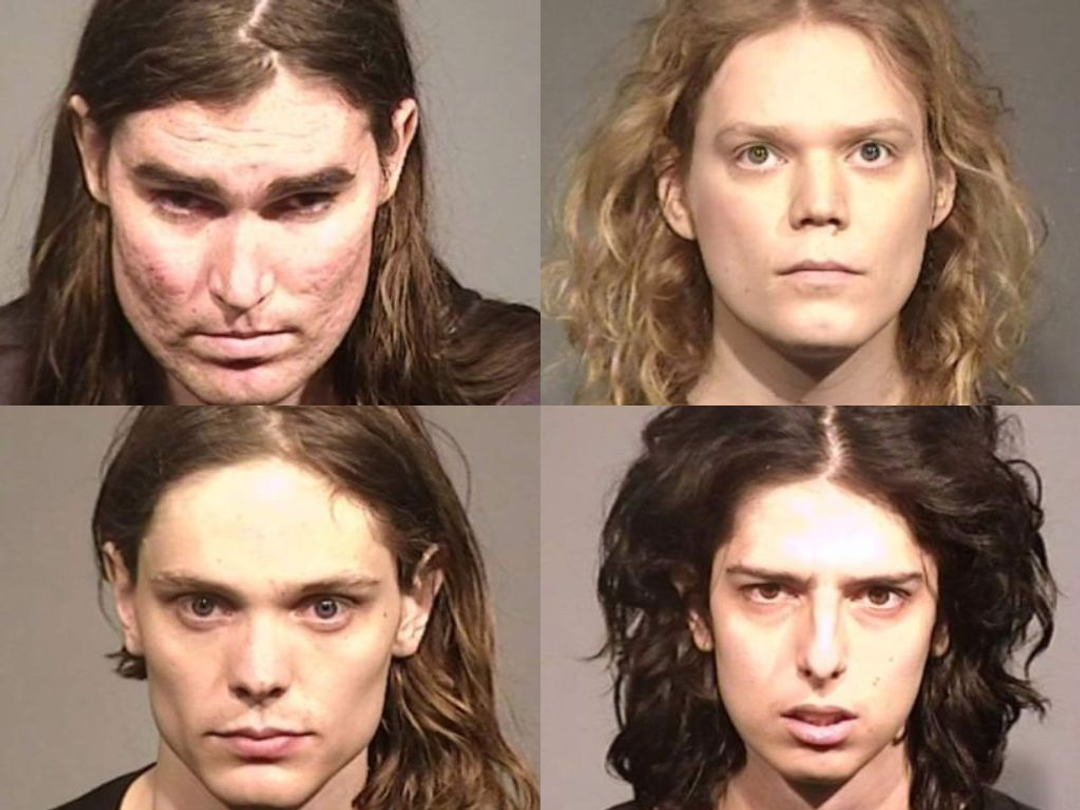
The photograph freezes the group at an important moment.
November 2019.
Before the killings. Before the disappearances. Before investigators in multiple states would begin encountering some of the same names.
At Westminster Woods, Jack LaSota, Gwen Danielson, Emma Borhanian, and Alexander Leatham had arrived together for a protest targeting the Center for Applied Rationality.
According to later reporting by WIRED, all four had connections to the rationalist, effective-altruist, and AI-risk communities. Their dispute with parts of that world had already grown increasingly hostile online before the confrontation at Westminster Woods.
Following the arrests, the four faced criminal charges and years of legal disputes.
But the group did not simply disappear after 2019.
Their paths continued.
And eventually, those paths would lead somewhere far darker.
THREE YEARS LATER
By 2022, the story had moved to Vallejo, California.
Emma Borhanian and Alexander Leatham—the two people pictured along the bottom row of that 2019 booking-photo composite—were living on property owned by an older man named Curtis Lind.
Lind had previously allowed members of the group to stay on his property.
But the relationship deteriorated.
According to later court testimony and reporting, a dispute developed over the property and money. Then, on November 13, 2022, the conflict exploded into violence.
Lind would later describe being confronted outside his home.
What followed involved a handgun, knives, and a sword.
When it was over, Emma Borhanian was dead.
Alexander Leatham had been shot.
And Curtis Lind had suffered catastrophic injuries—but survived.
THE MAN WHO SURVIVED
Evidence
CURTIS LIND — THE SURVIVING WITNESS
Curtis Lind survived the November 13, 2022 attack.
Prosecutors allege that Suri Dao lured Lind toward a supposed water leak before he was attacked. Emma Borhanian and Dao allegedly stabbed him with knives, while Alexander Leatham allegedly impaled him with a sword.
Lind managed to draw a handgun and fire at his attackers.
Borhanian was killed.
Leatham was wounded.
Lind survived—but suffered devastating injuries, including the loss of his right eye.
That survival created a problem for anyone who wanted the events of that morning to disappear.
Because Curtis Lind could testify.
documented
JANUARY 17, 2025
More than two years had passed since Curtis Lind survived the attack in Vallejo.
The criminal case against Alexander Leatham and Suri Dao was moving toward trial.
Lind was now 82 years old.
And he mattered enormously to the prosecution.
He was the surviving victim.
He was the eyewitness.
He was expected to testify.
Then, on January 17, 2025, Curtis Lind was attacked again.
This time, he did not survive.
Evidence
THE MURDER CHARGE
Authorities arrested 22-year-old Maximilian Snyder and charged him with the murder of Curtis Lind.
The criminal complaint alleged something even more disturbing than murder alone:
Prosecutors alleged that Lind was intentionally killed to prevent his testimony in a criminal proceeding—or in retaliation for testimony he had already given.
That allegation has not been established by a conviction and remains an accusation in the criminal case.
But it changed the shape of the story.
The surviving witness from the 2022 attack was now dead.
And another name had entered the network:
MAXIMILIAN SNYDER.
reported
THE NAMES KEEP RETURNING
By this point, the story no longer followed a straight line.
It crossed states. It crossed years. And the same small circle of names kept resurfacing around violence, investigations, arrests, and deaths.
Some knew one another personally. Others had encountered one another through the internet.
What connected them was not a conventional organization with membership cards, headquarters, or a public leader.
It was something far stranger: a network formed through online communities, shared ideas, personal relationships, and an ideology that outsiders would eventually associate with one name.
Ziz.
But understanding why investigators and journalists kept encountering that name requires going backward — before the killings, before the arrests, and before most people had any idea this world existed.
BEFORE THE BLOOD
Years before the names in this story became associated with killings and criminal investigations, they were connected to a much quieter world.
Online discussions about artificial intelligence. Rationalism. Ethics. Decision-making. The future of humanity.
These were communities built around questions most people never spend much time thinking about.
But somewhere inside that world, Jack LaSota began developing ideas of their own.
LaSota wrote online under the name “Ziz.”
The writings explored consciousness, morality, identity, artificial intelligence, and theories about how the human mind operates.
Over time, a small group of people became closely associated with LaSota.
Outsiders would eventually give them another name:
the Zizians.
Evidence
THE NAME “ZIZ”
Jack LaSota published writings online using the name “Ziz.”
Those writings became one of the primary public records for understanding the ideas associated with LaSota and the people who later became known as the Zizians.
“Zizian” was not originally the name of a conventional incorporated organization or formal membership group. It became a label used by journalists and others describing the network surrounding LaSota.
documented
THE DEAD WOMAN WASN'T THE ONLY PERSON WHO DISAPPEARED
Months before the Vallejo attack, Jack LaSota had seemingly vanished.
On August 19, 2022, the Coast Guard received a report that LaSota had fallen overboard in San Francisco Bay without a life preserver.
An extensive search followed.
After approximately 18 hours, the Coast Guard suspended the operation without finding LaSota.
More than two weeks later, an obituary appeared.
Then came November.
After the violent attack on Curtis Lind in Vallejo, investigators encountered a person identifying herself as Julia Dawson.
According to Coast Guard records later obtained by WIRED, Vallejo police contacted the Coast Guard with an extraordinary update:
LaSota was alive.
Police said the person who had identified herself as Julia Dawson was Jack LaSota.
THEN ANOTHER FAMILY ENTERED THE STORY
While California authorities dealt with the aftermath of the Vallejo attack, another branch of this network stretched across the country.
Michelle Zajko had become associated with LaSota's circle.
Her parents, Richard and Rita Zajko, lived in Pennsylvania.
Before long, their names would become part of this story too.
Not because of an online argument.
Not because of a protest.
Because both of them would be found dead.
Evidence
RICHARD AND RITA ZAJKO
Richard and Rita Zajko were shot and killed in Pennsylvania in late December 2022.
Their daughter, Michelle Zajko, would later become a person of interest in the investigation.
No conviction has established who murdered Richard and Rita Zajko.
Michelle Zajko has explicitly denied killing her parents.
But investigators would later uncover connections between people associated with that Pennsylvania investigation and an entirely different shooting hundreds of miles away.
documented
CALIFORNIA WAS NO LONGER THE WHOLE MAP.
Look at where the trail has taken us already.
California: a masked protest, an apparent disappearance, a sword attack, a dead woman, a surviving witness—and eventually that witness's murder.
Pennsylvania: two parents shot dead inside another unresolved homicide investigation.
The incidents were separated by geography and circumstance.
It would be irresponsible to pretend that every person in this network was responsible for every crime connected to it.
But investigators were beginning to encounter relationships that crossed those state lines.
And the next major event would make those connections impossible to examine one state at a time.
Curtis Lind's murder did not close this story.
It opened another door.
Three days later—on a highway in northern Vermont—a Border Patrol agent stopped a Toyota Prius.
Inside were two young people.
Investigators had already been watching them.
There were firearms in the vehicle.
Within minutes, two people would be dead.
And when federal investigators began examining the people, weapons, and relationships surrounding that shooting, names from other parts of this Rabbit Hole would surface again.
Level Cliffhanger
California was almost 3,000 miles away. That distance was about to stop mattering. On January 20, 2025, a Border Patrol agent approached a Prius on Interstate 91 in Vermont. Before that traffic stop was over, two people would be dead. And one of the guns recovered from the scene would lead investigators straight back into the network.
The rabbit hole continues
Descend to Level 3 →